Business communication has moved far beyond traditional phone systems. Companies today use cloud-based calling, automated assistants, intelligent workflows, and AI-driven conversations to connect with customers at scale.
Two technologies often discussed in this space are cloud telephony and conversational AI. Although they may work together, they are built for different purposes.
Cloud telephony primarily changes how calls are managed and delivered, while conversational AI changes how businesses communicate during those calls.
Understanding this distinction can help businesses choose the right technology for their customer service and sales operations.
What Is Cloud Telephony?
Cloud telephony is a phone system that operates through the internet rather than relying entirely on traditional on-premise telephone infrastructure.
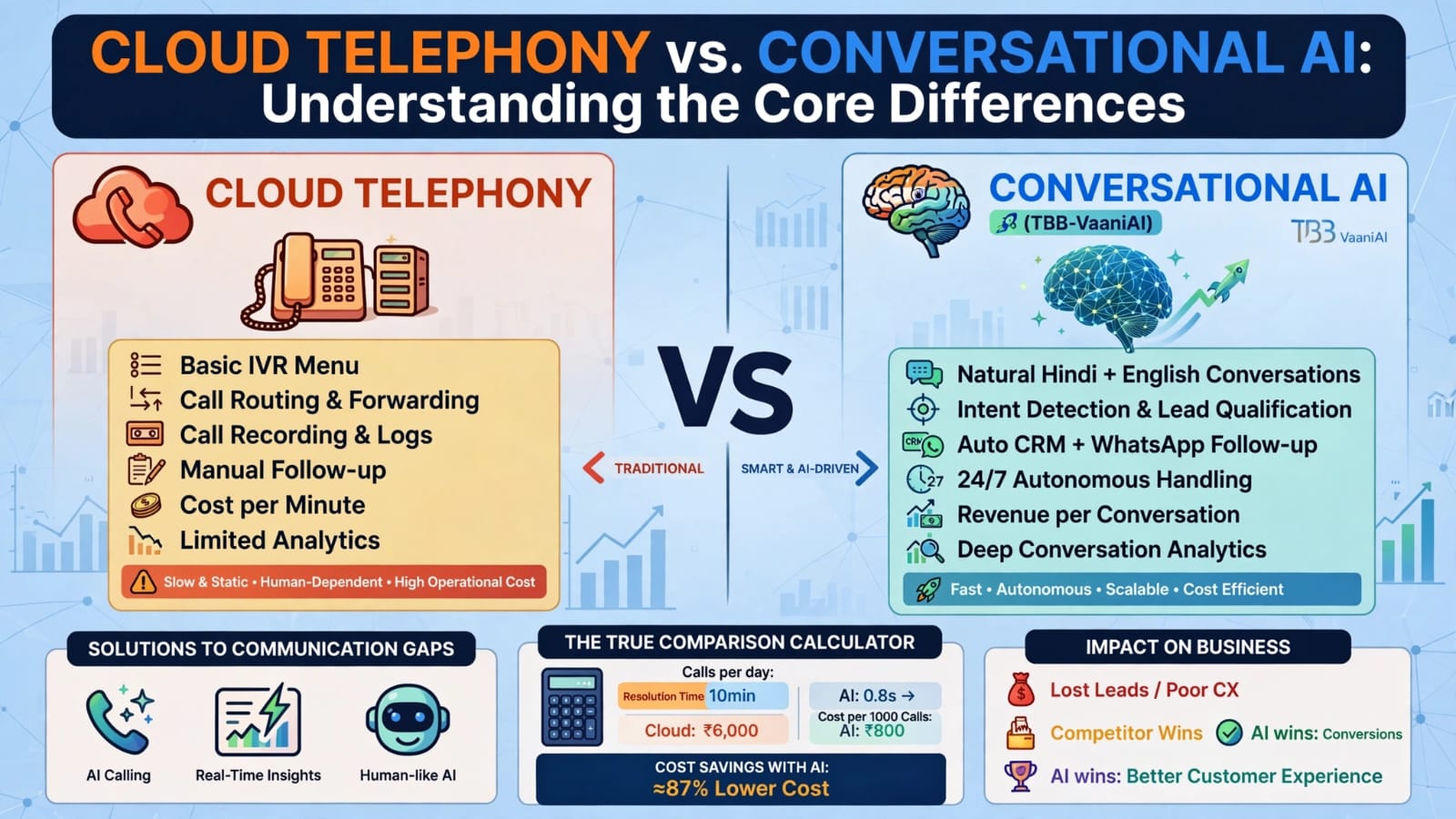
It gives businesses access to features such as:
- Virtual business numbers
- IVR menus
- Call routing
- Call recording
- Call forwarding
- Automated dialing
- Call monitoring
- Basic call analytics
What Is Conversational AI?
Conversational AI goes a step further.
Instead of simply connecting a caller to the right department or playing a pre-recorded message, conversational AI can understand what the customer says and respond accordingly.
An AI voice agent can handle conversations such as:
Customer: “I want to know about your pricing.”
AI: “Sure. I can help with that. Are you looking for the basic or business plan?”
The interaction is dynamic rather than being restricted to predefined menu options.
Conversational AI can be used for lead qualification, customer support, appointment scheduling, follow-ups, surveys, reminders, and other business conversations.
Cloud Telephony vs. Conversational AI
The simplest way to understand the difference is:
Cloud telephony provides the communication infrastructure.
Conversational AI provides intelligence within the conversation.
Think of cloud telephony as the phone system, while conversational AI acts more like the intelligent person operating that system.
1. How They Handle Conversations
Cloud telephony generally follows predefined rules.
For example:
Caller → IVR → Option → Department → Agent
Conversational AI can understand natural language and respond based on the context.
Caller → AI understands request → AI responds → Next action
This allows the conversation to change depending on what the customer actually says.
2. Level of Automation
Cloud telephony automates the movement of calls.
Conversational AI can automate parts of the conversation itself.
A cloud system may automatically route a customer to sales, while an AI voice agent could ask qualifying questions, collect information, answer common queries, and decide whether human assistance is needed.
3. Customer Experience
Traditional IVR systems often require customers to navigate menus.
Conversational AI allows customers to explain their requirements naturally.
Instead of:
“Press 1. Press 2. Press 3.”
the customer can simply say:
“I want to book a demo for tomorrow.”
The AI can understand the request and continue from there.
4. Use of Customer Data
Cloud telephony can record and track call information such as duration, time, number, and recordings.
Conversational AI can analyze the actual content of conversations.
It can identify information such as:
- Customer intent
- Buying interest
- Objections
- Frequently asked questions
- Sentiment
- Follow-up requirements
- Lead quality
This creates a richer source of information for sales and customer-service teams.
Can Cloud Telephony and Conversational AI Work Together?
Absolutely.
In fact, they are often more powerful when combined.
A business might use cloud telephony for its phone infrastructure while adding conversational AI to handle customer interactions.
A possible workflow could look like:
Customer calls → Cloud telephony receives call → AI understands request → AI handles conversation → CRM is updated → Human agent takes over if required
This combines reliable communication infrastructure with intelligent automation.
When Should a Business Use Cloud Telephony?
Cloud telephony can be a good choice when a business primarily needs:
- Business calling infrastructure
- IVR
- Call routing
- Virtual numbers
- Call recording
- Agent management
- Call tracking
- Integration with existing systems
It is especially useful for businesses that already have human agents and want better control over their calling operations.
When Does Conversational AI Make More Sense?
Conversational AI becomes valuable when the goal is to reduce repetitive human involvement and make customer interactions more intelligent.
Common applications include:
Lead Qualification
AI can contact prospects, ask relevant questions, identify their requirements, and determine whether they are worth pursuing.
Follow-Ups
Instead of relying entirely on sales representatives to remember every follow-up, AI can initiate conversations according to predefined workflows.
Customer Support
Frequently asked questions can be handled automatically, allowing human representatives to focus on more complex issues.
Appointment Scheduling
AI can communicate with customers, check requirements, and help schedule appointments without requiring a representative for every interaction.
Customer Surveys
Businesses can collect feedback through automated voice conversations and analyze responses at scale.
Where VaaniAI Fits In
VaaniAI brings conversational AI into the sales communication process.
Instead of treating calling as a standalone activity, VaaniAI connects AI voice conversations with lead qualification, CRM, follow-ups, analytics, and sales workflows.
This means a conversation can become more than just a completed call.
A prospect can be contacted, qualified, scored, added to the CRM, followed up with, and moved through the sales journey through one connected system.
For businesses looking beyond basic calling infrastructure, this creates an opportunity to build an AI-powered sales communication system rather than simply adding another calling tool.
The Key Difference in One Example
Imagine a real estate company receives 500 new leads.
A cloud telephony system can help the sales team call those leads, route calls, record conversations, and monitor activity.
Conversational AI can take the process further by contacting leads automatically, asking about budget and property preferences, identifying serious buyers, recording the information, and triggering the next step.
Conclusion
Cloud telephony and conversational AI are not necessarily competing technologies.
They solve different problems.
Cloud telephony provides the infrastructure needed to make business communication scalable and manageable. Conversational AI adds intelligence by allowing systems to understand, respond to, and learn from customer interactions.
As businesses move toward more automated customer journeys, the combination of both technologies can create a much more capable communication ecosystem.
The future isn't just about making more calls.